
A month ago, I received an email out of the blue from someone named Ioannis Tsiokos. He said that he had achieved a breakthrough in tiling theory: he had discovered a strongly aperiodic monotile in 3D. Such a shape is the 3D analogue of the hat: a shape that can pack all of 3D space with no gaps and no overlaps, but never in a way that repeats with perfect regularity. (The use of “strong” aperiodicity here is a significant feature of the discovery: in 3D we have known of a “weakly” aperiodic monotile for decades. This distinction disappears in 2D, and its precise meaning is not relevant in this essay.) Tsiokos’s email included a link to an online repository with a formal verification and downstream links to a technical preprint, expository articles, and interactive demos.
These online materials bear the imprint of AI slop from start to finish. I don’t think Tsiokos is making any particular effort either to broadcast this fact or to conceal it—the preprint ends with a straightforward declaration of the use of various LLMs. I had no interest in wading into a morass of slop to extract the small subset of useful information. Fortunately, I didn’t have to: Chaim Goodman-Strauss and Felix Flicker have stronger constitutions than mine, and each of them distilled the key ideas from the AI-generated preprint. Short and accessible papers by Chaim and Felix are both available on arXiv. And yes, it’s easy to see from these write-ups that the shape is indeed a strongly aperiodic monotile in 3D. But it’s not my aim to write about the mathematical aspects of this discovery.
This is the first time in our glorious new AI era that a breakthrough has encroached on my personal research interests, and the experience provoked an unusually large amount of introspection. I’m far from the first person to publish an essay about the impact of AI on research—there’s plenty of excellent reading to be found at Proofs and Prompts, or the many guest posts on Terry Tao’s blog. As it happens, I was goaded into capturing my feelings through an email conversation with a journalist: I said that this discovery made me sad, and she asked me to explain why. I thought I would publish an expanded version of my response here, if only to get it off my chest and create a record that I can return to later.
Before delving more deeply, let us pause to stipulate some largely uncontroversial concerns with the current state of AI technology. The Big Four, as I recently related them to students in my intro CS course this fall, are the environmental impact, the rampant theft of intellectual property, the cognitive and psychological harms, and the plague of hallucination and slop. In the past few months, I’ve added a fifth concern: the industry bringing us these technologies is run by rich, deluded jerks who are quickly getting richer, more deluded, and jerkier.
These are the basic table stakes in any broad conversation about the evils of Generative AI. Hallucination and slop are shortcomings in the output of AI systems, reasons to believe that the technology doesn’t work as well as we would like; the other concerns are important reasons to avoid the technology even if it worked.
I use AI tools as little as possible, maybe a few times a year. I can’t imagine using it to assist with writing. I’m opposed to using it to conduct research, though I confess I once used an LLM to generate about ten lines of especially gnarly C++ code that I couldn’t figure out myself. And over the past couple of months, I’ve been using it as a source of basic Linux tech support, to solve some annoying issues related to the configuration of this website. As a member of a Computer Science department at a large university, I’m in the minority here, but not a tiny minority. You’ll find a spectrum of AI use among my 100+ colleagues in CS: some of us use it non-stop all day long, while about a third of us never touch it.
Given the apparent successes achieved by AI in mathematical research just in the last year, it has become reasonable to ask why I continue to avoid it, beyond the Big Four concerns mentioned above. I’ll offer a high-minded, idealistic answer here, and then I’ll interrogate some of the ways that my answer might be inadequate for our current times.
Certainly I agree with the contents of the statement posted online by Terry Tao and his posse of Fields Medalists in “A Severe Misalignment of AI in Mathematics“. Here’s a relevant passage:
Famous problems have often served as landmarks and lighthouses against which one can measure an improved understanding of this landscape. Solving one of these problems has been a certain sign of new insights and interesting methods, which would then be studied by a community of mathematicians, through a long and arduous process of talks, discussions, simplifications.
In an age of AI-generated proofs, we lose some of that vigorous intellectual process. We face situations where a famous problem can be solved, but in way that betokens no improved understanding of the landscape. The papers being spewed onto the internet by AI companies, and their accompanying formalizations, tend to be garbled messes that happen to end with a final declaration of the truth or falsehood of a mathematical fact of interest. We receive the final outcome of our question, but in a way that produces no insight, and that fails to spin off useful new ideas, objects, and methods. Some of that will surely come after the fact—those write-ups by Chaim and Felix are the simplifications we’d want for the newly discovered 3D monotile. But it’s not too precious to claim that in the before times, there was value in the fact that human minds had to wrestle mightily with these problems in order to solve them. To some extent, we always knew that the path they took was more important than the final answer, even as we glorified researchers who furnished proofs to open problems.
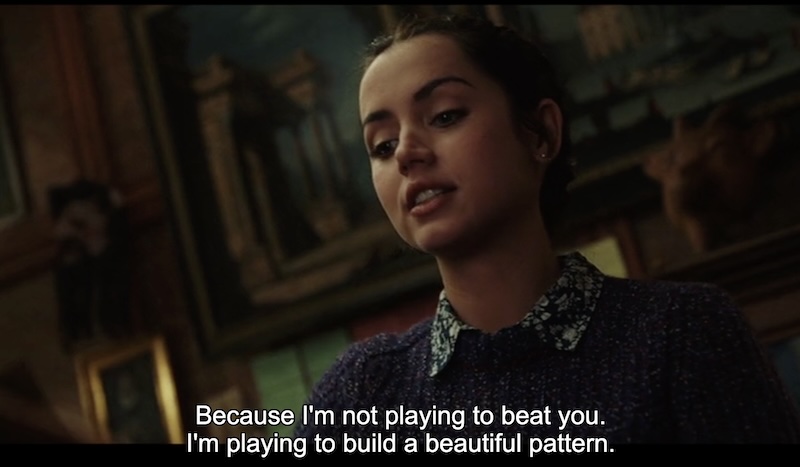
But there’s more to it than that. If the agony of mathematical research matters, then let us acknowledge the ecstasy as well. As I pondered the impact of AI on my own research, a line popped into my head from the 2019 movie Knives Out. Two characters are playing Go. The first asks, “Why can’t I beat you at this game?”, and the second responds, “Because I’m not playing to beat you; I’m playing to build a beautiful pattern.” It occurred to me that this sounds like a motto for my research (beyond the basic fact that a lot of my research is literally about building beautiful patterns). I don’t do research because I’m trying to be best, or first, or solve the most important problem, or write the most papers, or win the most awards. I do research because the process itself is a worthwhile human activity, one to which I am suited. I prize the difficult process of learning new ideas, and the creative struggle to push the frontier of knowledge. I feel joy and gratitude for the all-too-rare flashes of insight. I value the way that each project changes me, giving new mental tools to tackle the next one. I value the act of communicating complicated ideas. Right now, it seems to me that AI automation is the antithesis of these experiences.
Why would I deprive myself of the pleasure and struggle of research by subcontracting it to a machine, just to obtain the result faster? What’s the rush? It’s not like significant real-world stakes are riding on the existence of a 3D aperiodic monotile. More to the point, why would a presumably indifferent party like Tsiokos deprive others of that pleasure? Charitably, we can hope he’s genuinely interested in the problem, had a germ of an idea for its solution, and coached an LLM to turn that idea into a proof. More cynically, he might just want his name attached to the solutions to open problems in mathematics (though the extent to which the solutions are “his” is debatable). Whatever his motives, I don’t get the sense that he’s trying to build a Beautiful Pattern.
How, exactly, does AI automation contribute to human flourishing? The news is filled with stories of AI bringing physical, psychological, and financial harm to many people, building up all the way to questionable threats of human extinction. Even among my colleagues who use AI tools freely, many of them report doing so with feelings somewhere between reluctance and revulsion. There are precious few stories in which AI brings genuine improvement to the lives of real humans. The creators of these technologies seem to hint at a future techno-utopia of abundance, but you’d be right to worry that the riches of that future will be even less evenly distributed than the riches of the present.
I’m sad because AI threatens to rob a longstanding scholarly tradition of its humanity. I fear a forthcoming phase change, in which a stimulating collaborative activity gets replaced by a relentless, grim enumeration of mathematical truths. My sadness is an early taste of a deficit of future delight.
I want to shift gears, and acknowledge a few natural rebuttals to the romantic view of mathematical research presented above. These are tensions that I’m still struggling with in deciding how to conduct my own research, how to collaborate with others, and how to supervise graduate students.
Old man yells at cloud. I’m closer to the end of my career than the beginning. I have a suite of mathematical and computational tools that I’ve used for decades. I’m reluctant to adopt new tools, and slow to learn them when I do. For goodness’ sake, I still write most of my code using vim in a terminal window, eschewing even the basic niceties of syntax highlighting! (A former graduate student referred to my coding setup as “Vi Unimproved”.) So it’s quite possible that some of my feelings about AI tools are just the basic inertia of sticking with what I know, and refusing to invest time and energy on a hot new technology.
There’s got to be at least some truth to this attitude. As far as I remember, the survey that revealed that about a third of my colleagues don’t use AI tools didn’t ask us our ages. It would be interesting to see how strongly AI use among academics is (negatively) correlated with age. But that can’t be the whole story. Like I said, the core concerns regarding AI technology aren’t particularly controversial, even among people who use the technology regularly, and ought to be enough on their own to make us hesitant to adopt it. And all else being equal, I’d genuinely prefer to figure things out myself rather than having a magic box that grinds through the technical details of my research.
Of course, things are not always equal. This is most evident with my graduate students, who will emerge from the university into a job market that currently favours AI expertise. Even if I refuse to engage, I would probably be doing them a disservice by outlawing these tools. I’ve almost never dictated what technologies (e.g., programming languages) my students should use to solve their problems, though of course I’ve made recommendations (and LaTeX is a hard requirement for writing papers). I should extend that flexibility to AI. At present, their CVs probably benefit from basic familiarity with code generation tools.
The place where I might crack in my own work is the creation of apps for interactive visualization or experimentation. Generative AI can throw together a browser-based tool faster than I ever could, and with a more complete user interface. A good demonstration is Topkapi, created by David Bachman more or less by feeding ChatGPT a few old papers of mine. The interface is fussy in a characteristically AI-generated way, but it’s highly functional and polished. Code quality and performance don’t matter all that much. I could easily spend weeks coding up something comparable, without generating a lot of value from a research perspective. I’m still averse to using AI to do the actual research, but maybe open to letting it create the tool that demonstrates the research.
Moving the goalposts. As the AI companies race to publish new results in research mathematics, I worry that the general public will view the negative reaction among mathematicians as sour grapes. Our reaction must surely be just another echo of “robots are going to take our jobs”, a story at least as old as the original Luddites. Of course we’ll attempt to defend our territory, and suddenly start claiming that proof was never the main goal of mathematical research.
But that’s exactly right: proof really wasn’t the main goal. The general notion of proof is ancient, but the present standard of mathematical rigour by which we judge whether a theorem has been proven is itself a relatively recent invention (emerging about 100–150 years ago). The current outcry about insight and understanding over proof is an inevitable reaction to AI, but not a new idea—I’m pretty sure it was Gian-Carlo Rota who emphasized the importance of evidence over proof in the mid-20th century, but I can’t find the exact quote. Beyond that, it’s a common opinion that the work that has the greatest impact is more about asking the right questions, or defining the right terms, not just proving things.
Yes, it’s possible that proof became overvalued in the world of working mathematicians. As with many aspects of academia, we tend to streamline our means of evaluating faculty members to things we can measure easily, and proofs are a convenient unit of currency. In this respect, AI-generated mathematics might be a net win for mathematicians: it exposes the weakness of this focus on proof, and will perhaps open up other ways for us to demonstrate our value. (Of course, this point of view is self-serving as well, given that most of my research is not about writing proofs.)
Augmentation versus automation. This last point is is probably the most philosophical and hardest to resolve. MIT’s excellent report on AI in education includes a section titled “Augmentation not automation”. Their point is that there may be a genuine use case for AI, once you draw the line between enhancing your abilities and replacing them:
In the same spirit, collectively, we need to shape MIT’s use of AI in education to be “pro-learner” – not to replace the “hard fun” of thinking, learning, creating, and problem solving, but to expand what’s possible for students to think about, learn, and solve. In short, AI should be used to augment and enhance curiosity, creativity, and learning, not automate them.
In a recent email conversation, someone challenged me on this point. In brief, they observed that my research already sits atop a vast tower of technologies. I’m perfectly happy to use my computer’s operating system, and to use programming languages and compilers to write software that explores mathematical questions. I use optimization algorithms and tools like SAT solvers to find answers to questions that might otherwise be too difficult to solve directly. Why shouldn’t AI be just one more level to that tower, one more tool that streamlines grunt-work and extends my reach? Or should I retreat and conduct all my research with pencil and paper—or better yet purely in my mind, given that pencil and paper are themselves technologies?
I find this question deeply provocative, and I don’t have a ready answer, aside from the same old concerns over AI technology. To answer decisively, I would have to explain why AI is a fundamentally different kind of technology than what’s come before, and it’s difficult to know whether we should take any such claim seriously (after all, it’s just linear algebra). More to the point, a decisive answer would have to give me a way to know precisely where the line is between augmentation and automation. If I want to know whether I’m allowing a machine to think on my behalf, I must first know what it means for me to think, and also what it means for a machine to think. Both of those are likely to be unknowable for a long time.
I’ll be very curious to look back and see how my attitudes hold up over time. The horizon of significant change seems to be on the order of months right now. It is difficult to imagine what the mathematical landscape might look like in a couple of years, and predicting anything over decades is laughable. For now I’ll continue to practice my old-time religion, even if it risks pushing me into irrelevance.
Leave a Reply